
One in every classroom: new research reveals the scale of abuse in teen relationships
The equivalent of one teenage child in every classroom reports having been subjected to physical or sexual abuse in a romantic relationship in the past year, according to new research.
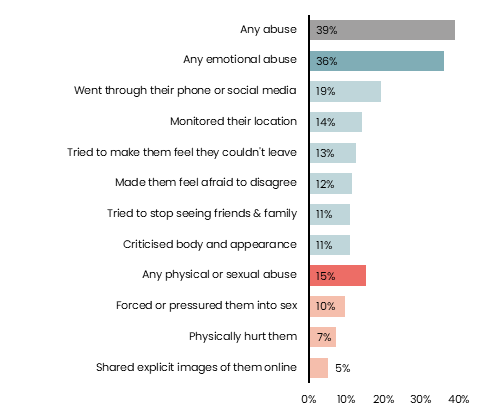
A survey of nearly 11,000 young people aged 13 to 17 found that 28% had been in a relationship in the past 12 months. Of those, 15% said they’d experienced physical or sexual abuse — including being forced or pressured into sex, physically hurt or having explicit images shared without their consent. That’s around 4% of all teenage children in England and Wales — roughly one in every 25 teenagers or one pupil in every typical-sized classroom.
The Youth Endowment Fund’s new research provides one of the clearest pictures yet of how many young people experience violence and abuse in their relationships. Every young person deserves to feel safe and respected in their relationships — yet the findings show that for too many, that trust is undermined by control, pressure or violence.
Emotional abuse is common
Among teenage children who had been in a relationship in the past year, over a third (36%) said they’d experienced emotionally abusive or controlling behaviour. That’s equivalent to around one in ten of all teenage children. The most common were having a partner check their phone or social media to see who they’d been talking to (19%) or monitor their location (14%). Girls were slightly more likely than boys to experience emotional or physical abuse from a partner (41% compared with 37%).
Chart 1: Proportion of 13-17-year-olds in relationships who’ve experienced emotional or physical abuse
The link between abuse at home and abuse in relationships
Teenage children who had experienced domestic abuse at home were much more likely to experience abuse in their own relationships. Around three in five of those who’d been physically hurt by a parent or guardian, or seen adults at home hurting each other, said they’d gone on to engage in emotionally or physically abusive behaviour towards a partner — compared with fewer than one in five of those who hadn’t experienced abuse at home.
The impact on young people’s lives
Most teenage children (76%) who had experienced any form of relationship abuse said it had affected their daily life. The most common impacts were emotional — four in ten said they often felt down, bad about themselves or had been worrying a lot (40%) — and many reported having trouble sleeping, losing their appetite or struggling to concentrate (39%). Over a third (34%) said their experiences had affected their relationships with friends or family, while nearly a quarter (22%) said they’d avoided going to school or college because of what had happened with their partner.
In some areas, the impact was greater for girls – they were more likely than boys to say they felt down, bad about themselves or had been worrying a lot (45% compared with 32%), and to report changing their appearance as a result (30% compared with 17%).
Lessons for prevention
When asked about the acceptability of sexually aggressive or non-consensual behaviours, most teenage children rejected harmful attitudes — 86% said it’s never okay to pressure someone into dating or sex after they’ve said no.
But with 5% saying it was sometimes or always okay, and with emotional and physical abuse appearing in so many teenage relationships for both girls and boys, the findings highlight just how important lessons on healthy relationships are for all young people.
Evidence shows that lessons delivered by trained, confident facilitators and teachers can make a difference. A global review found that lessons about healthy relationships can reduce relationship violence by 17%.
To build on this, the Youth Endowment Fund is calling on the government to invest £38 million to pilot and roll out a Violence Against Women and Girls (VAWG) Lead training grant across every school and college in England and Wales, 500 secondary Alternative Provision settings in England, and every Pupil Referral Unit in Wales.
The funding would enable schools to appoint a staff member as a VAWG Lead, responsible for designing and delivering a strategy to prevent relationship violence and abuse. It would also support specialist training for teachers, and allow schools, colleges and alternative provision settings to deliver at least five relationship violence prevention lessons to Year 9 pupils and 16-17 year olds in colleges.
Jon Yates, CEO at the Youth Endowment Fund, said: “When one young person in every classroom is likely to be experiencing abuse in their relationship, the classroom has to be part of the solution. Evidence shows high-quality lessons delivered by a trained teacher or youth worker can make a difference. Every teenager should learn what a healthy relationship looks like — and every school needs the funds, training and support to make that happen.”
Zara*, YEF Youth Advisory Board member, said: “I think there needs to be more conversations about understanding your boundaries. And not just in relationships, in friendships too. I also think we need to educate young people about what exactly relationship violence is and the different aspects of it. Often, when you think of it, you think of just one thing. But there are so many different scenarios that can contribute.”
* Name has been changed
Download the full report
The YEF’s annual Children, Violence and Vulnerability reports provide the most comprehensive and up-to-date analysis of children’s experiences of violence in England and Wales.
Download the second report in this year’s four-part series: Violence in relationships
ITV News’ The Rundown
The Youth Endowment Fund is collaborating with ITV News’ The Rundown to bring this story about teens to teens — explaining the findings and hearing their experiences. Watch on TikTok @itvtherundown and YouTube @ITVTheRundown.
Children, Violence and Vulnerability 2025
The Youth Endowment Fund’s annual Children, Violence and Vulnerability report offers the most comprehensive and up-to-date analysis of children’s experiences with violence in England and Wales.
The findings are based on an online survey of 10,835 children aged 13 to 17 in England and Wales. Conducted by Savanta (a member of the British Polling Council) between May and July 2025. The survey aimed to ensure national representation by setting quotas for key demographics, including age, gender, ethnicity, region and socioeconomic status. These quotas were informed by the 2021 Census population estimates for 13 to 17-year-olds. The results were then weighted to align with national population totals.
Download the full reports here:
- Report 1: The scale of violence affecting children
- Report 2: Violence in relationships
- Report 3: Mental health and experiences of violence (published on 9 December)
- Report 4: Exploitation and gangs (published on 16 December)