
Cognitive Behavioural Therapy – Skills Programmes
Structured programmes that use cognitive behavioural techniques to teach practical skills for managing emotions, solving problems, and responding safely to conflict.
What is it?
Cognitive Behavioural Therapy (CBT) skills programmes teach children and young people to understand how thoughts and beliefs can affect their feelings and behaviour, and give them practical skills to respond more safely to difficult situations. We have summarised the evidence on clinical CBT delivered by trained therapists or psychologists, here.
CBT skills programmes can be delivered as targeted support or as universal provision. Targeted programmes are often designed for children and young people displaying behavioural or emotional difficulties, experiencing mental health difficulties, involved in offending, at risk of exclusion, or involved with social care services. Universal programmes are usually delivered in schools, for example, to a whole class or year group.
CBT skills programmes are most often delivered in schools. They can be delivered by an array of trained staff, including educational psychologists, counsellors, teachers, youth workers, mental health practitioners, or external providers. Programmes can also be delivered in youth justice and community settings, and social care settings. Less commonly, they are delivered online or through a mix of online and face-to-face sessions.
Programmes usually follow a structured curriculum or manual and are typically short-term, with most lasting between one and three months.
The skills covered often include:
- managing anger and other strong emotions
- solving problems and thinking through the consequences of different actions
- building social and communication skills
- using coping strategies such as self-soothing or breathing exercises
- setting personal goals and working towards them
- seeing situations from other people’s point of view and speaking up assertively
Children practise these skills through activities such as role-play, games, group discussion, stories, video clips, worksheets and practice tasks. Some programmes also involve parents, carers or school staff, who may be given information about what children are learning and encouraged to support practice between sessions.
Is it effective?
The research suggests that, on average, the impact of Cognitive Behavioural Therapy skills programmes on preventing violence is likely to be high.
The evidence suggests that CBT skills programmes may reduce violence by 72%.
The research also estimates that, on average, CBT skills programmes may reduce crime and offending by 71%.
CBT skills programmes were also found to have a high impact on reducing behavioural difficulties, regulating emotions, improving mental health and self-esteem, increasing engagement in school, and reducing victimisation.
How secure is the evidence?
We have moderate confidence in our estimate of the impact of CBT skills programmes on violence.
We gave this rating because whilst the estimate is based on 22 studies, most studies were moderate quality, with only 3 high quality studies. Two studies were conducted in the UK, and 20 were conducted internationally, including the US, Turkey, Nigeria, Iceland, Spain, Pakistan and the Netherlands.
Our confidence in the estimate of the average impact of CBT skills programmes on crime and offending is very low because it is based on only four studies. Of these, one was moderate quality, 2 were low quality, and one was very low quality. All studies were conducted in the US.
The studies that produced the impact ratings on these outcomes assessed the effectiveness of this approach for 4,154 children and young people.
Who does it work for?
There is limited evidence on how the effectiveness of CBT skills programmes may differ for different groups of children and young people. Three moderate quality studies, from Nigeria and the US, explored outcomes by gender and ethnicity. No high or moderate quality studies explored whether impact differed by age, socio-economic status, special educational needs or disabilities, neurodiversity, or care-experience.
Gender
Two studies found no clear differences in impact by gender. One study found greater improvements for girls on some outcomes, including verbal aggression and social anxiety-related thoughts, but did not find gender differences for depression or self-esteem.
Ethnicity
The review suggests that the impact of CBT skills programmes does not differ for different ethnic groups, however this is based on weak evidence.
How can you implement it well?
The review found 13 studies that provided evidence related to implementation, including 2 from the UK and 11 from the Netherlands, Spain and the US.
Provide manuals, structured training, and monitoring of delivery
Provide facilitators with manuals, resources, structured training and regular supervision to support consistent delivery. Use scripted session plans to guide sessions, and use post-session checklists, recordings or direct observations to check whether the programme is being delivered as intended.
Fit the programme around existing commitments
Where programmes are not part of school curriculum, children and young people may need to participate in these programmes around their school routine, appointments, and family circumstances. Programmes should be structured and sustained, but realistic to deliver and attend. Very frequent sessions may be harder to maintain in practice, so use flexible delivery to support attendance. Only schedule intensive weekend sessions where there is clear appetite from children and their families.
Maximise engagement through varied activities
Use practical activities, such as games, role-play, or practice tasks, to help children to apply CBT skills to familiar situations. Where rewards or incentives are used, keep them proportionate and linked to participation, effort or skills practice.
Consider hybrid delivery to include in-person and online sessions
Consider delivering a hybrid programme that combines in‑person sessions with access to online activities and resources to support accessibility and engagement. Monitor participation, safeguarding, and access. Co-create ground rules with children and young people so that online sessions feel safe, respectful and manageable.
Align the programme design with children’s development
Tailor activities to children’s cognitive and social development and any learning or neurodevelopmental needs. Younger children may need more structured, concrete, and interactive materials, including art activities, scenarios and games.
Involve parents, carers or trusted adults
Involve parents, carers or other trusted adults in the child’s support system. This could include school staff, youth workers, social workers or other practitioners who can help children practise skills between sessions. Their involvement should support the child’s engagement and use of CBT skills but should not become a barrier to access where family involvement is not safe, possible or appropriate.
How much does it cost?
On average, the cost of CBT skills programmes is likely to be high.
Cost estimates from current UK programmes suggest an average cost of around £4,000 per child.
Costs usually involve trained staff to deliver the programme, programme materials, training, supervision and programme management.
Costs will vary depending on the frequency and length of sessions, who delivers the programme, the level of supervision required, and the delivery format.
Topic summary
- CBT skills programmes teach children and young people practical skills to identify and manage thoughts, feelings and behaviour in difficult situations. They often include emotional regulation, anger management, problem-solving, perspective-taking, and assertive communication skills.
- CBT skills programmes are estimated to have a high impact on reducing violence, with an estimated 72% reduction. We have moderate confidence in this estimate of impact. It is also estimated to have a high impact on reducing offending, however this is based on weak evidence.
- The evidence base includes both universal and targeted CBT skills programmes. The review did not directly compare them, but it found the most consistent benefits for children with behavioural dysregulation and for programmes delivered in school settings.
- Programmes are most often delivered in schools. Implementation is likely to be stronger when programmes use manuals, structured training for practitioners, and varied activities matched to children’s developmental needs.
- Effectiveness can be enhanced with the engagement of parents/carers or other adults in the child or young person’s support system.
- On average, the cost of CBT skills programmes is likely to be high.
Take away messages
- Put in place Cognitive Behavioural Therapy skills programmes, for children and young people displaying behavioural difficulties, mental health needs or emotional difficulties, and those at-risk of involvement in violence. Consider universal school-based delivery where it fits local needs and support pathways.
- Commission providers that have the capacity to deliver CBT skills programmes consistently, and can adapt to children’s needs and development, in school, community, or custodial settings.
- Monitor who takes part and whether children with SEND, neurodiversity, care experience or other support needs are able to access, engage with and benefit from the programme.
YEF projects and evaluations
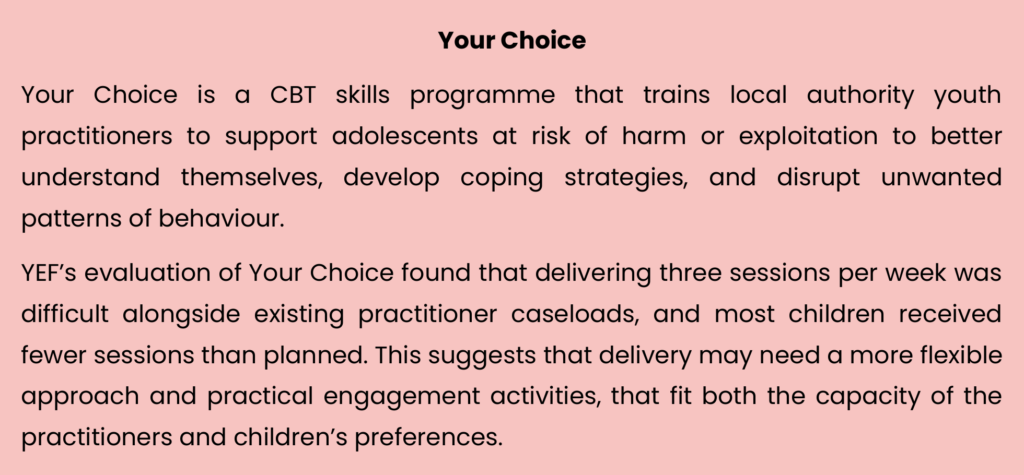
Your Choice aims to build trusting relationships and support the child to better understand themselves, develop coping strategies, and disrupt unwanted patterns of behaviour.
External links
BABCP: Cognitive Behavioural Psychotherapist Accreditation
Clear explanation about recognised CBT practice standards.
DfE: Promoting and supporting mental health and wellbeing in schools and colleges
School based delivery and whole school mental health approaches.
Anna Freud: Mental health toolkit for schools
School and college mental health provision planning toolkit.