
 Youth Sector
Youth sector policy and violence prevention
System guidance for policymakers in England and Wales on preventing children and young people’s involvement in violence


Violence affects too many children and young people across England and Wales. In our Children, violence and vulnerability report, nearly one in five 13–17-year-olds reported being a victim of violence in the past year, and one in eight reported committing violence. The impact is serious, long-lasting, and extends far beyond those directly involved.
About the guidance
This guidance report aims to help prevent this violence. It focuses on the system changes needed to strengthen the youth sector’s role in violence prevention. It provides policymakers across England and Wales with six evidence-based policy recommendations that would make it easier for the youth sector to deliver ‘what works’.
The six recommendations sit within three broad themes: reforming youth sector funding, shaping the rollout of existing policy commitments to better support vulnerable children and young people and strengthening youth workers’ role in safeguarding from extra-familial harm.
The recommendations are based on the best available international evidence on what works to reduce children and young people’s involvement in violence. The report uses this evidence to identify where youth provision can help prevent violence, while recognising that the sector has broader aims and benefits for children and young people. Our Strategic Advisory Group and Youth Advisory Board, together with an Expert Panel of youth sector leaders, policy specialists, and academics, have shaped this guidance to ensure the recommendations are feasible and relevant.
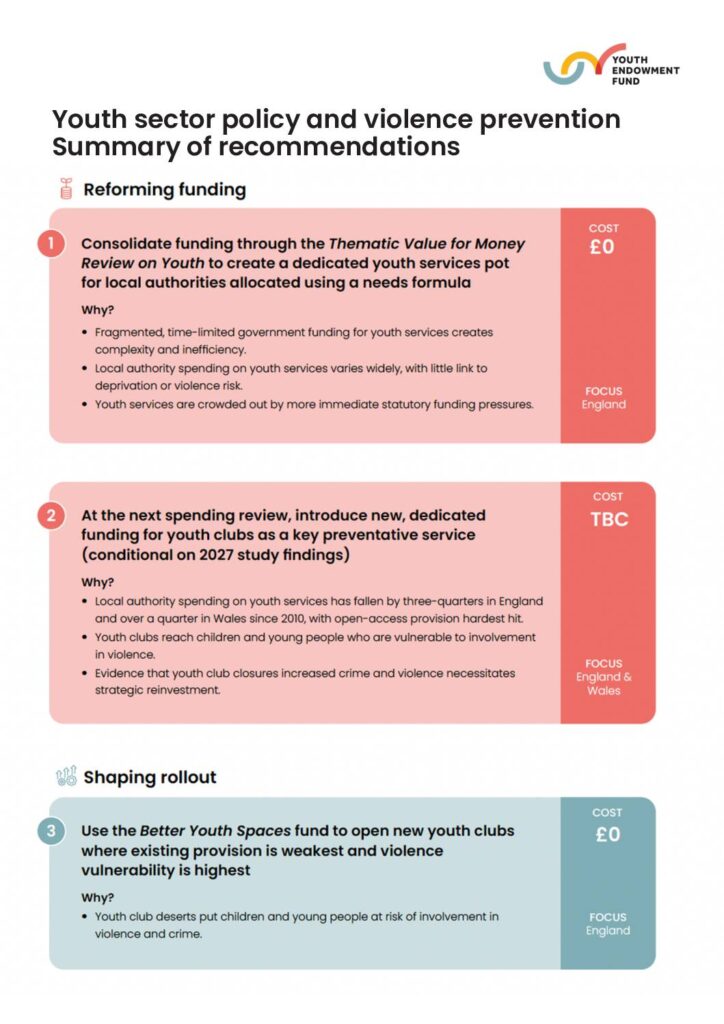
Recommendations
 Reforming funding
1
Consolidate funding through the Thematic Value for Money Review on Youth to create a dedicated youth services pot for local authorities allocated using a needs formula
Why?
- Fragmented, time-limited government funding for youth services creates complexity and inefficiency.
- Local authority spending on youth services varies widely, with little link to deprivation or violence risk.
- Youth services are crowded out by more immediate statutory funding pressures.
COST
£0
FOCUS England
2
At the next spending review, introduce new, dedicated funding for youth clubs as a key preventative service (conditional on 2027 study findings)
Why?
- Local authority spending on youth services has fallen by three-quarters in England and over a quarter in Wales since 2010, with open-access provision hardest hit.
- Youth clubs reach children and young people who are vulnerable to involvement in violence.
- Evidence that youth club closures increased crime and violence necessitates strategic reinvestment.
COST
TBC
FOCUS England & Wales
 Shaping rollout
3
Use the Better Youth Spaces fund to open new youth clubs where existing provision is weakest and violence vulnerability is highest
Why?
- Youth club deserts put children and young people at risk of involvement in violence and crime.
COST
£0
FOCUS England
4
Incorporate evidence on ‘what works’ into guidance for Young Futures Hubs
Why?
- Without grounding in evidence, Young Futures Hubs could adopt violence and crime prevention approaches that are unproven or harmful.
- Impact depends not only on what Hubs offer but on how support is targeted, designed and delivered.
COST
£0
FOCUS England
 Strengthening safeguarding
5
Ensure training reforms prepare youth workers to respond to the range of violence involving children and young people while working alongside partner agencies
Why?
- Youth workers encounter overlapping forms of violence, including violence against women and girls (VAWG).
- Youth workers provide trusted support to vulnerable children and young people whilst navigating complex multi-agency systems.
COST
£0
FOCUS England & Wales
6
Update statutory safeguarding guidance to strengthen youth workers’ role throughout responses to extra-familial harm
Why?
- Youth workers are too often left out of multi-agency responses to extra-familial harm affecting the children and young people they support.
- Existing safeguarding guidance gives limited and inconsistent attention to the youth sector’s distinct role.
COST
£0
FOCUS England & Wales
Introduction from the Head of Change for the Youth Sector
In this short video, Caleb Jackson, YEF’s Head of Change for the Youth Sector, introduces the guidance and explains the six policy recommendations that would make it easier for the youth sector to deliver ‘what works’.
Addressing racial disproportionality
Most children and young people involved in violence are White. However, relative to their share of the population, some minority ethnic groups – particularly Black children and young people – are disproportionately affected by violence, both as victims and perpetrators.
The youth sector is well-placed to help tackle this disproportionality: across England and Wales, children and young people from Black and mixed ethnic backgrounds are more likely to attend youth clubs and to have a trusting relationship with a mentor than those from White ethnic backgrounds.
The recommendations in this report aim to strengthen the youth sector and the support it provides to children and young people from the communities most affected by violence. For example, because Black children and young people are over-represented in youth clubs, recommendations on dedicating funding for youth clubs (Recommendation 2), opening new youth clubs in youth club deserts (Recommendation 3) and incorporating ‘what works’ evidence into Young Futures Hubs guidance (Recommendation 4) should particularly benefit Black children and young people.
Do these recommendations apply to England and Wales?
Youth provision is a devolved policy area, so the systems in England and Wales differ. Half of the recommendations apply equally to England and Wales. Within the report, recommendations focused on England include a ‘What about Wales?’ box, setting out specific actions for the Welsh Government. This report contains fewer standalone recommendations for Wales because Wales has already made substantial progress in building the infrastructure needed for high-quality youth provision.
Reviews of practice
In addition to drawing from the YEF Toolkit, the Children, Violence and Vulnerability Survey, insights from young people collected by our Peer Action Collective’s (PAC) peer researchers, and more, this guidance also draws from three YEF-funded reviews of youth sector practice, including:
Youth workers’ role in safeguarding
The following review explores the role that youth workers and youth work organisations play in safeguarding systems. With thanks to the National Youth Agency in partnership with Professor Carlene Firmin and the Contextual Safeguarding research programme at Durham University.

Youth clubs’ role in supporting children at risk of or involved in violence
The following review examines how youth clubs are set up and operated, what encourages at-risk children to attend and engage, what kinds of support are offered, and what changes to policy and practice could strengthen their contribution to violence prevention. With thanks to RSM UK Consulting in partnership with the National Youth Agency and Carmen Villa from the University of Warwick.

Youth sector funding and decision-making
The following review examined youth sector funding and decision-making across England and Wales. It identified the varied sources of funding for youth provision, mapped local authority funding of youth provision against need, and explored decision-makers’ priorities for youth provision. With thanks to SQW and UK Youth.