
 Policing
Policing, Children and Violence
Practice guidance for senior police leaders on reducing children’s involvement in violence.

Violence affects too many children across England and Wales. In our Children, Violence and Vulnerability report, nearly one in five 13–17-year-olds reported being a victim of violence in the past year, and one in eight reported committing violence. The impact is serious, long-lasting, and extends far beyond those directly involved.
About the guidance
This guidance report aims to prevent this violence. It offers senior police leaders six evidence-based recommendations to reduce children’s involvement in violence. The recommendations focus on three key areas: treat children as children, focusing on positive interactions and effective safeguarding; focus on what works, prioritising approaches that have the best chance of reducing violence; and do diversion well, making it effective and fair.
This guidance is primarily written for senior police leaders in England and Wales – including Chief Constables, Assistant and Deputy Chief Constables and Chief Superintendents – and thematic leads in policing with responsibility for relevant areas – including children, custody, safeguarding, serious violence, stop and search, and prevention. It is also relevant for officers and staff who are involved in policing that interacts with children, including frontline police, supervisors and specialist staff. Wider policing partners, governance and oversight bodies can also use this guidance. This includes Police and Crime Commissioners (PCCs), Mayoral Offices exercising PCC functions and Violence Reduction Partnerships.
The recommendations are based on the best available international evidence on what works to reduce children’s involvement in violence. Our Strategic Advisory Group of senior police leaders, together with an Expert Panel of police officers, staff, commissioners and academics, have shaped this guidance to ensure the recommendations are feasible, relevant and useful.
Recommendations
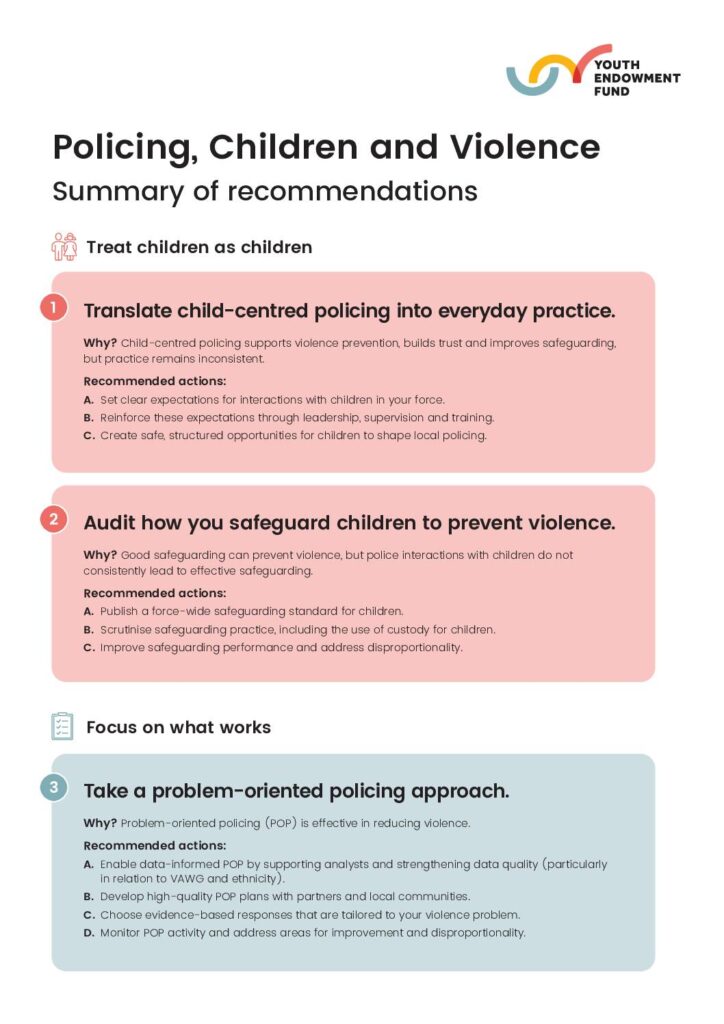
 Treat children as children
1
Translate child-centred policing into everyday practice.
Why? Child-centred policing supports violence prevention, builds trust and improves safeguarding, but practice remains inconsistent.
Recommended actions:
A. Set clear expectations for interactions with children in your force.
B. Reinforce these expectations through leadership, supervision and training.
C. Create safe, structured opportunities for children to shape local policing.
2
Audit how you safeguard children to prevent violence.
Why? Good safeguarding can prevent violence, but police interactions with children do not consistently lead to effective safeguarding.
Recommended actions:
A. Publish a force-wide safeguarding standard for children.
B. Scrutinise safeguarding practice, including the use of custody for children.
C. Improve safeguarding performance and address disproportionality.
 Focus on what works
3
Take a problem-oriented policing approach.
Why? Problem-oriented policing (POP) is effective in reducing violence.
Recommended actions:
A. Enable data-informed POP by supporting analysts and strengthening data quality (particularly in relation to VAWG and ethnicity).
B. Develop high-quality POP plans with partners and local communities.
C. Choose evidence-based responses that are tailored to your violence problem.
D. Monitor POP activity and address areas for improvement and disproportionality.
4
Stop harmful approaches and deprioritise unevidenced approaches.
Why? Limited resources should be directed to approaches with the best chance of reducing violence.
Recommended actions:
A. Conduct an annual assessment of your local violence prevention activity.
B. Stop delivering approaches that are likely to increase violence (including prison awareness programmes and boot camps).
C. Deprioritise approaches where impact on violence is unknown (including knife education programmes, media campaigns and police in schools).
5
Improve the quality of stop and search.
Why? Good quality stop and search practice is more likely to reduce violence. Poor quality practice can lead to unfairness and damage trust in policing.
Recommended actions:
A. Scrutinise stop and search of children, driving improvements in the strength of grounds and quality of interactions.
B. Monitor, publish and address racial disproportionality in stop and search of children.
C. Provide refresher training on stop and search to frontline officers.
 Do diversion well
6
Build an effective and fair out-of-court resolution approach.
Why? Out-of-court resolutions (OOCRs) can reduce violence, but they are often used ineffectively and unfairly.
Recommended actions:
A. Establish an OOCR protocol for children with your local youth justice service(s).
B. Monitor your OOCR approach for children and address areas for improvement and disproportionality.
Introduction from Assistant Director of Change for Policing and Youth Justice
In this short video, YEF’s Assistant Director of Change for Policing and Youth Justice introduces the guidance and outlines how senior police leaders can use the recommendations to prevent children’s involvement in violence.
Addressing racial disproportionality
Most children involved in violence are White. However, relative to their share of the population, some minority ethnic groups – particularly Black children – are disproportionately affected as both victims and perpetrators. This disproportionality is driven by factors such as poverty, racism, and unequal access to support.
Policing has committed to reducing racial disproportionality and preventing racism, and police forces have relevant legal duties under the Public Sector Equality Duty. Addressing racial disproportionality is essential for fair and effective policing: over-policing can unnecessarily criminalise children and weaken diversion and safeguarding, while under-protection can leave them exposed to violence.
All six recommendations in this guidance are expected to help tackle racial disproportionality and ensure that all children are better protected from involvement in violence.
Reviews of practice
In addition to drawing from the YEF Toolkit, the Children, Violence and Vulnerability Survey, insights from young people collected by our Peer Action Collective’s (PAC) peer researchers, and more, this guidance also draws from four YEF-funded reviews of policing practice, including:
A review of evidence-based practice in policing to prevent children from becoming involved in violence.
This review explored the use of evidence-based practice in policing to prevent children from becoming involved in violence. It examined current delivery of violence prevention strategies, knowledge of the evidence-base on what works, and the changes needed to support delivery of evidence-based strategies. With thanks to Cordis Bright.

Child-centred policing in practice: insights from children and young people.
This research explored children and young people’s views on how policing could become more child-centred, specifically how police can build trust and listen in encounters with them. Children and young people identified a set of eight child-centred principles for operational policing practice which were then refined with police. The research was co-designed with two young advisory groups. With thanks to the University of Bedfordshire and the University of Lancashire.

Safeguarding children involved in violence: insights for ‘best practice’ in policing.
This review explored the role of police in safeguarding children involved in violence, focussing on insights for best practice. It examined what best practice looks like, frontline awareness of this practice, and barriers and enablers to delivering good safeguarding approaches. With thanks to the University of Lancashire and the University of Bedfordshire.

Policing’s response to children’s exploitation in drug markets.
This review explored policing’s response to children’s exploitation in drug markets. It examined how these markets operate, current policing responses, how intersecting vulnerabilities shape children’s risks of exploitation and criminalisation, and the changes needed to better safeguard children and reduce harm. With thanks to the University of Durham.