
 Children's Services
Children’s services and violence prevention
Practice guidance for senior leaders in children’s services on how to protect children from involvement in violence.
Violence affects too many children across England and Wales. In our Children, violence and vulnerability report, nearly one in five 13–17-year-olds reported being a victim of violence in the past year, and one in eight reported committing violence. The impact is serious, long-lasting, and extends far beyond those directly involved.
About the guidance
This guidance report aims to help protect children from involvement in violence. It offers senior leaders in children’s services seven evidence-based recommendations focused on three areas: strengthening safeguarding responses to extra-familial harm (including serious violence); improving access to evidence-based interventions; and proactively safeguarding children in care from violence.
The guidance is primarily written for senior leaders in children’s services in England and Wales, including Directors of Children’s Services and Assistant Directors in England, and Directors of Social Services in Wales. It is also relevant to commissioning leads, Local Safeguarding Children Partnerships (England) and Regional Safeguarding Boards (Wales), practice leaders, including Principal Social Workers, Practice Supervisors, Heads of Service and Service Managers responsible for safeguarding, child protection, early help, family support and children in care.
Children’s services have a central leadership role in safeguarding children from violence, but they cannot do this alone. Delivery of most of the recommendations depends on strong multi-agency collaboration, with children’s services working closely with police, health, education, youth justice and the youth sector.
The recommendations are ‘best bets’ based on the best available evidence. They draw on the YEF Toolkit, the Children, violence and vulnerability survey, YEF-funded reviews of practice and programme evaluations, insights from the Peer Action Collective, and the expertise of YEF’s Strategic Advisory Group, Youth Advisory Board and an Expert Panel of children’s services and violence prevention leaders, commissioners, academics and young people. An accompanying evidence-to-decision framework sets out the full underpinning evidence.
Recommendations
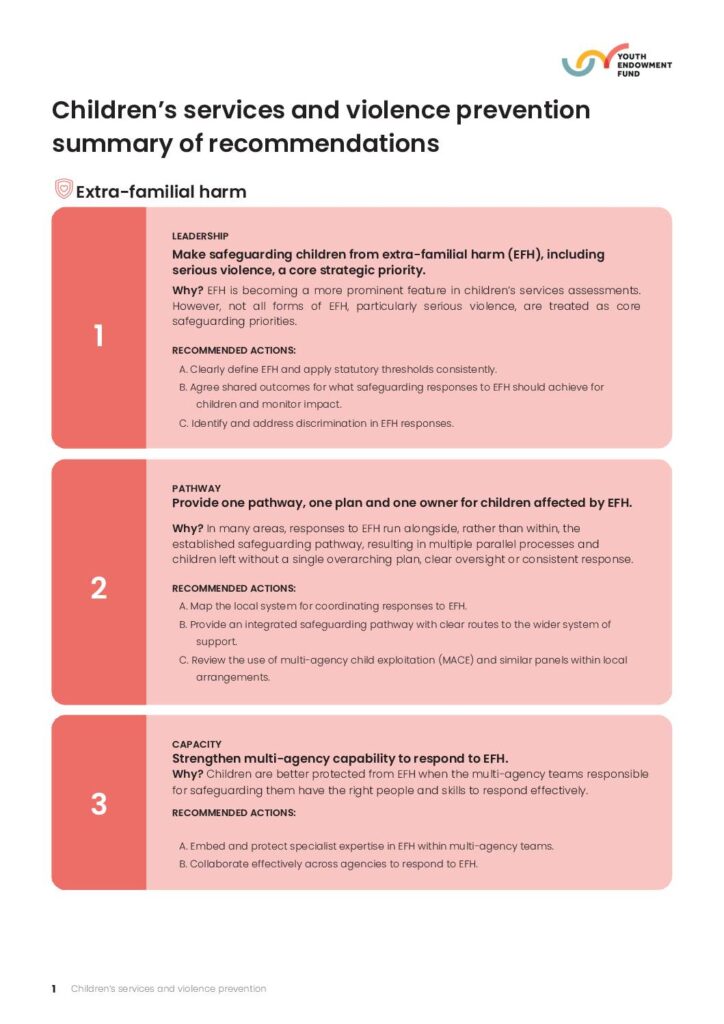
 Extra-Familial Harm
1
LEADERSHIP
Make safeguarding children from extra-familial harm (EFH), including serious violence, a core strategic priority.
Why? EFH is becoming a more prominent feature in children’s services assessments. However, not all forms of EFH, particularly serious violence, are treated as core safeguarding priorities.
Recommended actions:
- Clearly define EFH and apply statutory thresholds consistently.
- Agree shared outcomes for what safeguarding responses to EFH should achieve for children and monitor impact.
- Identify and address discrimination in EFH responses.
2
PATHWAY
Provide one pathway, one plan and one owner for children affected by EFH.
Why? In many areas, responses to EFH run alongside, rather than within, the established safeguarding pathway, resulting in multiple parallel processes and children left without a single overarching plan, clear oversight or consistent response.
Recommended actions:
- Map the local system for coordinating responses to EFH.
- Provide an integrated safeguarding pathway with clear routes to the wider system of support.
- Review the use of multi-agency child exploitation (MACE) and similar panels within local arrangements.
3
CAPACITY
Strengthen multi-agency capability to respond to EFH.
Why? Children are better protected from EFH when the multi-agency teams responsible for safeguarding them have the right people and skills to respond effectively.
Recommended actions:
- Embed and protect specialist expertise in EFH within multi-agency teams.
- Collaborate effectively across agencies to respond to EFH.
 Evidence-based interventions
4
Offer high-quality mentoring for children at risk of involvement in violence.
Why? Trusting relationships with safe adults can protect children from violence, but mentoring provision is patchy and many programmes only offer short-term support.
Recommended actions:
- Make mentoring a core part of the safeguarding and wider support offer.
- Ensure mentoring is high-quality and relationships are sustained.
- Prioritise mentoring for children in care and care leavers.
5
Provide evidence-based parenting and family therapy programmes to improve parenting practices or family functioning, and reduce behaviour difficulties in children.
Why? Evidence-based parenting programmes and family therapy can reduce children’s behavioural difficulties linked to later involvement in violence.
Recommended actions:
- Prioritise programmes that have been robustly evaluated.
- Match the programme type to children’s and families’ needs.
- Build a flexible support offer and equip practitioners to deliver it effectively.
- Monitor take-up, completion and outcomes by demographics and address gaps.
6
Support access to therapy for children who are at risk of involvement in violence
Why? Psychological therapies, such as cognitive behavioural therapy, can reduce children’s involvement in violence.
Recommended actions:
- Jointly commission evidence-based CBT and support children to engage.
- Monitor access to mental health support and improve referrals.
 Prioritising children in care
7
Proactively safeguard children in care from violence
Why? Care-experienced children face increased risks of exploitation, instability and criminal justice contact, and are less likely to receive a safeguarding response or diversion.
Recommended actions:
- Provide stable placements that protect children from EFH.
- Ensure care plans proactively identify and reduce risks of EFH.
- Provide high-quality training to foster carers and residential staff to support children affected by EFH.
- Develop local protocols for reducing criminalisation of children in care and care leavers.
The recommendations set out what good practice looks like, but children’s services’ ability to deliver them may be constrained by wider system pressures. These include significant financial pressure on local authorities, shortages in suitable care placements and reliance on other stretched services such as mental health support. YEF will set out recommendations for the broader system in 2027 that aim to tackle some of these challenges.
Video summary
In this short video, YEF’s Head of Change for Children’s Services introduces the guidance and outlines its seven recommendations for helping children’s services protect children from involvement in violence.
Addressing racial disproportionality
If we are to prevent serious violence, we must also tackle racial disproportionality. Most children involved in violence are White. However, relative to their share of the population, some minority ethnic groups — particularly Black children — are overrepresented in violence victimisation and perpetration. This disproportionality is driven by factors such as poverty, racism, and unequal access to support.
This guidance aims to tackle this disproportionality. Recommendation 1 asks local leaders to identify and address discrimination in responses to extra-familial harm. Recommendation 5 calls for leaders to monitor whether parenting and family therapy programmes are reaching and benefiting families from all communities, including ethnic minority communities. Recommendation 6 calls for culturally responsive therapy and action to address racial disparities and adultification bias in access to mental health support. Recommendation 7 calls for scrutiny of whether responses to children in care, including police call-outs, vary by race and ethnicity, so disproportionate criminalisation can be addressed.
Case study in practice

Children’s services and violence prevention: Expert and youth insight
Watch these short films that bring together insights from our Children’s services Strategic Advisory Group, who contributed to this guidance. Each video explores a different aspect of responding to extra‑familial harm — from safeguarding pathways and multi‑agency working to the vital role of youth voice. Together, they offer practical reflections to support local areas in strengthening their approach to protecting children from harm both inside and outside the home.
Reviews of practice
In addition to drawing from the YEF Toolkit, the Children, Violence and Vulnerability Survey, insights from young people collected by our Peer Action Collective’s (PAC) peer researchers, and more, this guidance also draws from a new review of children’s services practice, including:
Prioritising protection
This report explores two key parts of the safeguarding response to extra-familial harm: multi-agency operational panels that coordinate responses to children and young people, and the strategic safeguarding partnerships that oversee this work. It examines Multi-Agency Child Exploitation panels and alternatives to them, alongside Local Safeguarding Children Partnerships in England and Regional Safeguarding Boards in Wales. The review considers how these arrangements operate, how well they identify and protect children, and what local and national changes could strengthen safeguarding responses.
With thanks to Professor Carlene Firmin, Hannah King and the wider research team at the Global Centre for Contextual Safeguarding at Durham University, working in partnership with Research in Practice, the Association of Safeguarding Partners and the National Policing Vulnerability Knowledge and Practice Programme.