
 Youth Sector
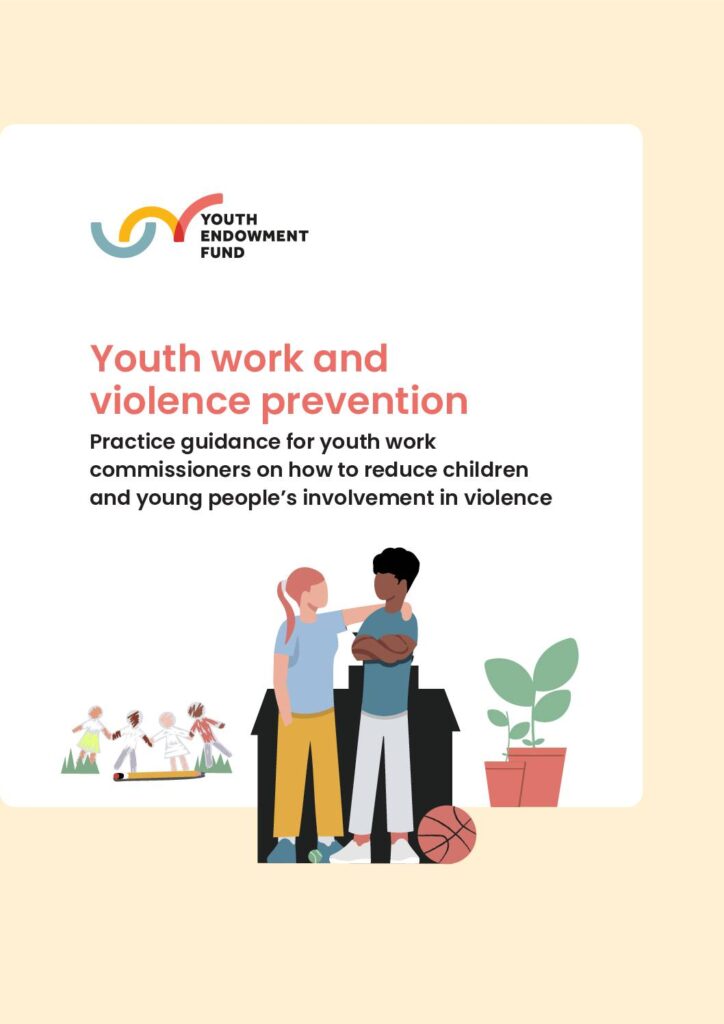
Youth work and violence prevention
Practice guidance for youth work commissioners on how to reduce children and young people’s involvement in violence

Violence affects too many children and young people across England and Wales. In our Children, violence and vulnerability report, one in five 13–17-year-olds reported being a victim of violence in the past year, and one in eight reported committing violence. The impact is serious, long-lasting, and extends far beyond those directly involved.
About the guidance
This guidance report aims to prevent this violence. It offers youth work commissioners eight evidence-based recommendations to reduce children and young people’s involvement in violence. These recommendations emphasise getting the right focus on vulnerable children and young people and high-risk contexts, funding approaches that work, and laying strong foundations for high-quality youth work.
The guidance is primarily written for local funders and commissioners of youth work in England and Wales – including local authorities, Violence Reduction Units (VRUs), and housing associations – whose decisions shape the local youth work system. It is also relevant for philanthropic funders, and for youth workers and sector leaders who want to design effective services and advocate for the conditions needed to deliver high-quality support.
The recommendations are based on the best available international evidence on what works to reduce children and young people’s involvement in violence. Our Strategic Advisory Group and Youth Advisory Board, together with an Expert Panel of youth sector leaders, commissioners and academics, have shaped this guidance to ensure the recommendations are feasible and relevant.
Introduction from the Head of Change for the Youth Sector
In this short video, YEF’s Head of Change for the Youth Sector introduces the guidance and outlines how funders and commissioners can use the recommendations to prevent children and young people’s involvement in violence.
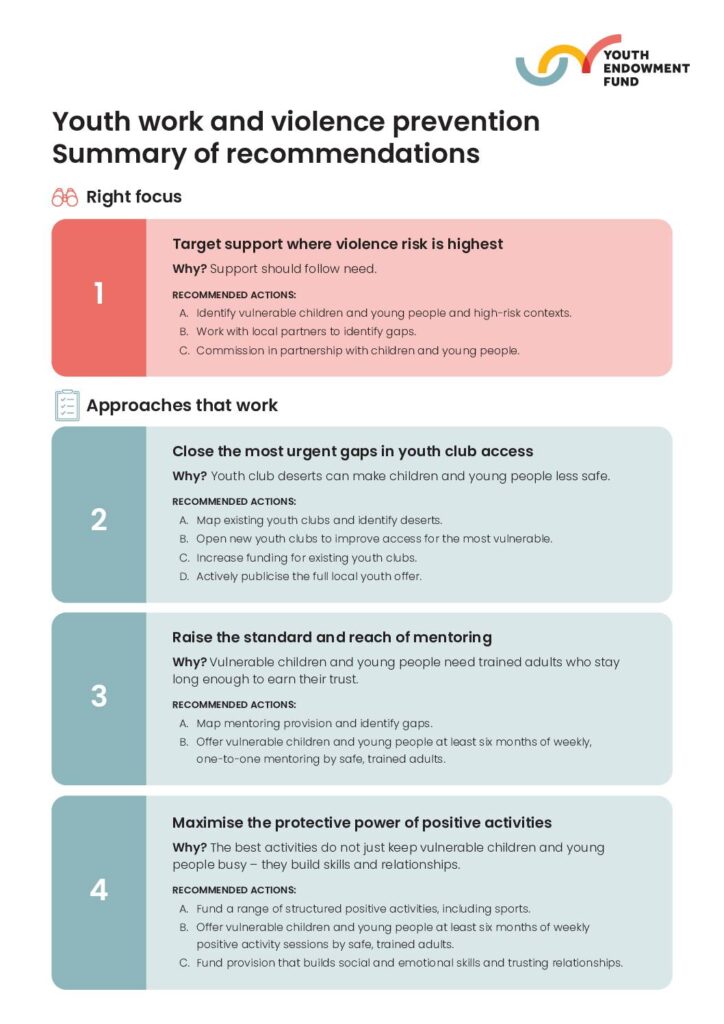
Recommendations
 Right focus
1
Target support where violence risk is highest
Why? Support should follow need.
Recommended actions:
- Identify vulnerable children and young people and high-risk contexts.
- Work with local partners to identify gaps.
- Commission in partnership with children and young people.
 Approaches that work
2
Close the most urgent gaps in youth club access
Why? Youth club deserts can make children and young people less safe.
Recommended actions:
- Map existing youth clubs and identify deserts.
- Open new youth clubs to improve access for the most vulnerable.
- Increase funding for existing youth clubs.
- Actively publicise the full local youth offer.
3
Raise the standard and reach of mentoring
Why? Vulnerable children and young people need trained adults who stay long enough to earn their trust.
Recommended actions:
- Map mentoring provision and identify gaps.
- Offer vulnerable children and young people at least six months of weekly, one-to-one mentoring by safe, trained adults.
4
Maximise the protective power of positive activities
Why? The best activities do not just keep vulnerable children and young people busy – they build skills and relationships.
Recommended actions:
- Fund a range of structured positive activities, including sports.
- Offer vulnerable children and young people at least six months of weekly positive activity sessions by safe, trained adults.
- Fund provision that builds social and emotional skills and trusting relationships.
5
Embed sustained support in high-need A&E departments
Why? Vulnerable children and young people need ongoing follow-up support, not brief signposting.
Recommended actions:
- Target support to the children and young people who need it most.
- Make caseworkers available in the right places and times.
- Combine sustained direct support with access to evidence-based interventions.
- Equip caseworkers for the demands of the role.
 Strong foundations
6
Make multi-year core funding the default
Why? Short term, restricted funding can weaken the quality of youth provision.
Recommended actions:
- Offer funding that lasts 3-5 years.
- Fund everyday core operating costs.
- Fund providers to collect and use data to improve quality and inclusion.
7
Equip youth workers to safeguard children and young people
Why? Youth workers already safeguard vulnerable children and young people from violence – often without the necessary support.
Recommended actions:
- Fund regular supervision and specialist training for youth workers.
- Involve youth workers in local safeguarding and/or community safety systems.
8
Prioritise evidence-based strategies and avoid harmful approaches
Why? Limited resources are best spent on violence prevention strategies that are supported by evidence.
Recommended actions:
- Use robust evidence to inform decision-making.
- Be aware that many violence prevention strategies have limited evidence.
- Avoid approaches that have been proven to cause harm.
The role of youth workers
Youth workers are the golden thread running through this guidance. Trusting relationships between children and young people and the adults who support them are central to preventing violence and supporting positive outcomes.
Throughout this guidance, the term ‘youth worker’ is used inclusively. It refers to anyone delivering youth work in practice – including qualified youth workers, mentors, sports coaches, volunteers, and caseworkers – regardless of job title or qualification.
Addressing racial disproportionality
Most children and young people involved in violence are White. However, relative to their share of the population, some minority ethnic groups – particularly Black children and young people – are disproportionately affected by violence, both as victims and perpetrators.
Five of the eight recommendations in this guidance are expected to help tackle racial disproportionality by strengthening the support available to children and young people from Black, Asian, and other minority ethnic backgrounds.
Case study in practice

AudioActive – SHIFT mentoring programme
AudioActive’s mentoring programme SHIFT provides one to one support for young people aged 11-17. We visited the team in Brighton to learn more about the programme.
Reviews of practice
In addition to drawing from the YEF Toolkit, the Children, Violence and Vulnerability Survey, insights from young people collected by our Peer Action Collective’s (PAC) peer researchers, and more, this guidance also draws from four new reviews of youth sector practice, including:
Youth workers’ role in safeguarding
The following review explores the role that youth workers and youth work organisations play in safeguarding systems. With thanks to the National Youth Agency in partnership with Professor Carlene Firmin and the Contextual Safeguarding research programme at Durham University.

Youth clubs’ role in supporting children at risk of or involved in violence
The following review examines how youth clubs are set up and operated, what encourages at-risk children to attend and engage, what kinds of support are offered, and what changes to policy and practice could strengthen their contribution to violence prevention. With thanks to RSM UK Consulting in partnership with the National Youth Agency and Carmen Villa from the University of Warwick.
Current practice in A&E Navigator programmes for youth violence prevention in England and Wales
The following review maps A&E Navigator services against need across England and Wales. It explores the support services offer and how children and young people with violence-related injuries engage with available programmes. With thanks to the University of Bristol and the University of Glasgow.

Youth sector funding and decision-making
The following review examined youth sector funding and decision-making across England and Wales. It identified the varied sources of funding for youth provision, mapped local authority funding of youth provision against need, and explored decision-makers’ priorities for youth provision. With thanks to SQW and UK Youth.