Found but NOT followed
Oversight of children vulnerable to violence below statutory thresholds

Background
This project was developed in response to a gap identified through the Youth Endowment Fund’s work with local violence prevention partnerships, as part of our Area Leaders Programme.
- Oversight of children who are vulnerable to involvement in violence, but who do not meet statutory thresholds for children’s social care or youth justice intervention is often patchy or absent.
- There is limited practical guidance for partnerships that want to improve oversight.
- There is no single statutory framework that requires a named professional to keep track of these young people, to check whether the support they were referred to was ever accessed, or to record what happened next.
To better understand this gap, YEF commissioned the Centre for Safer Society to conduct an evidence review, national survey and case study interviews to explore how local areas maintain oversight of children vulnerable to involvement in violence who do not meet statutory thresholds and identify insights for practice to strengthen local approaches.
Key findings
Local areas have systems for identifying children at risk of violence, but few systematically track their outcomes. All areas involved in the fieldwork had mechanisms for identifying and initially reviewing children at risk of involvement in violence. However, few tracked their outcomes in a structured way. Over half of national survey respondents either did not know how outcome data was collected in their area or reported that it was not collected systematically.
Unclear responsibilities and short-term funding were the most commonly reported barriers to effective oversight. Only 9% of practitioners who responded to our national survey said that roles and responsibilities for overseeing these children were very clear in their area.
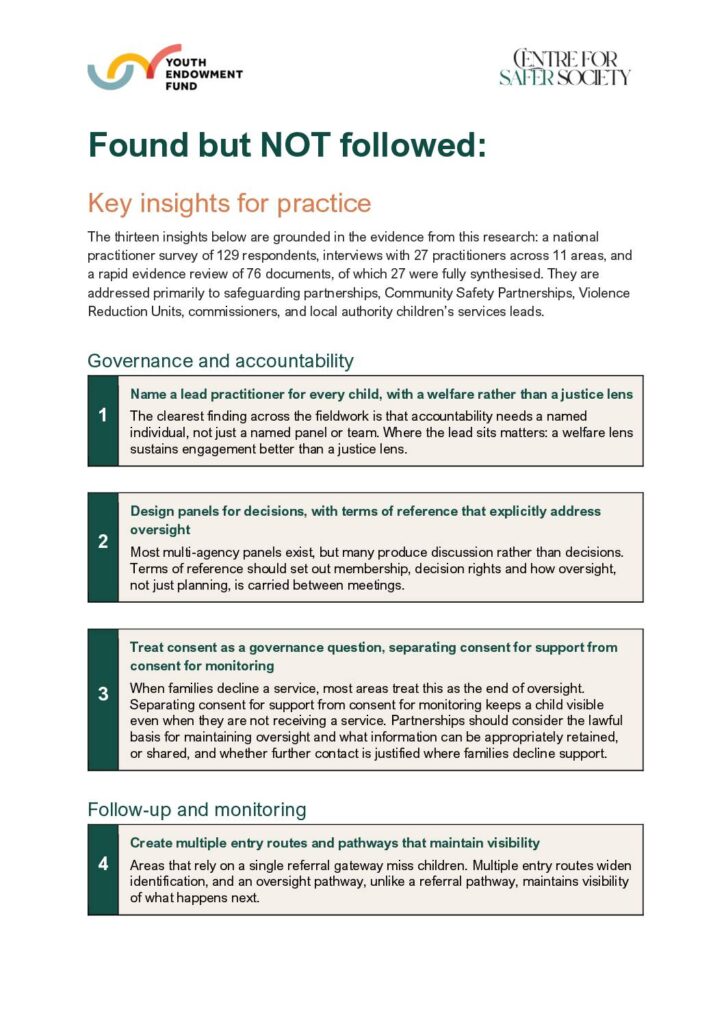
There is no single model of best practice; however, the research identified several common features in stronger approaches. These included having a named lead practitioner for each child; structured reviews at regular intervals, including after case closure; systems for monitoring outcomes; strong relationships between services; and stable funding to sustain support over time.
The research found strong evidence that Black and Mixed Heritage children are overlooked when they need protection and highly visible when associated with harm, with adultification bias shaping threshold decisions. No fieldwork area disaggregated its oversight, panel or outcome data by ethnicity, sex, age or special educational needs, and only 2 out of 129 survey respondents discussed race equity in their responses. As a result, no area could say whether its oversight system was working equitably.