Violence among teens falls, but small minority report daily behaviours linked to fixation
- 2.3% of teenagers report behaviours linked to violence fixation daily or almost daily.
- 56% of this group often feel socially isolated, compared with 14% of all teens.
- Teen victims of serious violence fall from 5.2% in 2025 to 3.1% this year.
Just over 2% of teenagers in England and Wales report engaging in behaviours that could indicate a fixation on violence every day or almost every day, according to new research from the Youth Endowment Fund (YEF). The findings come as the proportion of teenagers seriously hurt by violence has fallen.
The murder of three children in Southport in July 2024 raised urgent questions about how a young person can become drawn towards extreme violence without a clear or fixed ideology. Those questions are now at the centre of Phase 2 of the Southport Inquiry, which is examining how to identify and manage the risk posed by violence-fixated individuals.
YEF surveyed nearly 10,000 teenagers to understand how common these behaviours are and how they relate to young people’s wider experiences.
Behaviours linked to violence fixation
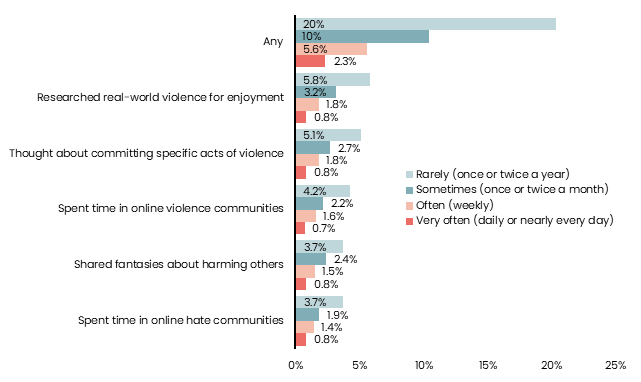
YEF asked teenagers aged 13 to 17 how often they engaged in five behaviours linked to violence fixation. These included looking up real-world attacks or attackers because it felt exciting or enjoyable, thinking about committing specific acts of violence, and sharing thoughts or fantasies about harming others. The other behaviours involved spending time in online communities focused on violence, or in communities promoting hatred or violence towards people because of their race, religion, gender or sexuality.
Some 2.3% of teenagers reported engaging in at least one of these behaviours daily or nearly every day. A wider group, 5.6%, did so at least weekly.
FIGURE 1: PROPORTION OF 13-17-YEAR-OLDS IN ENGLAND AND WALES WHO’VE ENGAGED IN VIOLENCE FIXATION-RELATED BEHAVIOURS
Isolation, injustice and time online
Many of the teenagers who engaged in these behaviours daily or almost daily felt like outsiders. Over half (56%) often felt socially isolated, excluded or as though they didn’t belong, compared with 14% of teenagers overall. More than six in ten (62%) also frequently thought about wrongs or injustices done to them, compared with 10% of all 13 to 17-year-olds.
Time spent online was another striking feature. Over half (52%) spent six hours or more, compared with 24% of teenagers overall, while 30% spent at least eight hours a day, more than twice the proportion of teenagers overall (13%).
Much higher rates of serious violence
These teenagers were also far more likely to report having been involved in serious violence in the past year. Three in ten (30%) had been hurt badly enough to need medical treatment from a doctor or hospital, nearly ten times the rate among all 13 to 17-year-olds (3.1%). A similar proportion (32%) reported they had hurt someone badly enough that they needed medical treatment, around 18 times the rate among teenagers overall (1.8%).
However, these findings do not mean that teenagers who engage in these behaviours intend to hurt anyone or will go on to commit serious violence. Over two-thirds (68%) of this group had not committed serious violence in the past year.
Violence affecting children is falling
While teenagers who reported these behaviours daily or almost daily were much more likely to report serious violence, the wider survey found that violence affecting teenagers has fallen.
The survey found that the proportion who had witnessed violence in the past year fell from 50% in 2025 to 42% in 2026. The proportion who had been victims of violence serious enough to need medical treatment fell from 5.2% to 3.1%, equivalent to roughly 120,000 13- 17-year-olds across England and Wales. The proportion who had committed it fell from 3.3% to 1.8%, or roughly 70,000 13–17-year-olds across England and Wales.
Official statistics analysed in YEF’s Beyond the Headlines report show a similar downward trend among young people. In 2024/25, there were 63 homicide victims aged 16–24, the lowest figure in over a decade and down from 106 the previous year. The number of children aged 0–17 admitted to hospital following knife assaults fell to 409, 100 fewer than the year before. Meanwhile, the number of 10–17-year-olds cautioned or convicted for violent offences fell by 3% over the same period.
Jeremy Miles, CEO of the Youth Endowment Fund, said: “We shouldn’t sensationalise these findings or assume that children who engage with violent thoughts or content are destined to hurt someone. For some young people, feeling that they don’t belong or have been wronged may be part of a wider picture that we need to better understand, including where they spend their time online. We need to look beyond the behaviour, understand what’s happening in these children’s lives and recognise where they may need help.”
Children’s Commissioner Dame Rachel de Souza said: “We have to look at what is driving young people to become fixated by violence – some may have been exposed to harmful content online, others may be vulnerable to exploitation, experience difficulties with their mental health or display concerning behaviours for a number of reasons. I want to see agencies like the Youth Endowment Fund working on evidence-based interventions for children at risk of harming others.
“As I set out in my evidence to the Southport Inquiry, I am concerned that our system – and especially Prevent – isn’t set up to respond to children fixated by violence but with no clear ideology. That is why I have called for radical reform including a new ‘front door’, referral pathway and evidence-based interventions for children at risk of harming others so that professionals working with children have the expertise and support to identify children’s needs and behaviours, to intervene early and provide the appropriate intervention to prevent behaviours from escalating.”
Turning evidence into action
The findings highlight the importance of understanding children’s experiences and recognising where they may need support. For teenagers who feel isolated or struggle with difficult experiences, approaches such as mentoring, cognitive behaviour therapy, social and emotional learning and positive activities offer evidence-backed ways to support young people and help prevent violence.
YEF has published practical guidance for education leaders, children’s services and the youth sector, setting out how professionals can use the evidence to help prevent children becoming involved in violence.
Kian, aged 18, said: “Violence can start from young. It builds up from not getting any emotional support – perhaps from their parents or siblings. So, when they encounter their first act of violence, they don’t know how to react. Whatever they feel, their emotions will dominate their actions. If they feel angry, then they could feel inclined to attack back. It depends on their emotional intelligence and well-being. This could be heavily guarded if a person doesn’t have a trusted adult.”
Sanaa, aged 17, said: “When you meet these kids and you live in an area with them, you realise they’re bright and they’re just really scared and don’t really know any better. They’re not getting many opportunities. They will turn to violence because that’s really all they know. If there were better education and more role models who maybe stepped out of gangs and actually had an input and helped these young youths come back out of this nasty world that they’re living in, then I reckon there wouldn’t be so much violence.”
Download the full report
- Report
Report:Children, violence and vulnerability 2026
Each year, we ask thousands of teenagers across England and Wales about their experiences of violence. This year we’re publishing the findings as a series of themed reports. Each one looks at a different side of how violence shapes children’s lives. CEO Jeremy Miles, and Youth Advisory Board Members Jess and Elijah discuss the importance…